
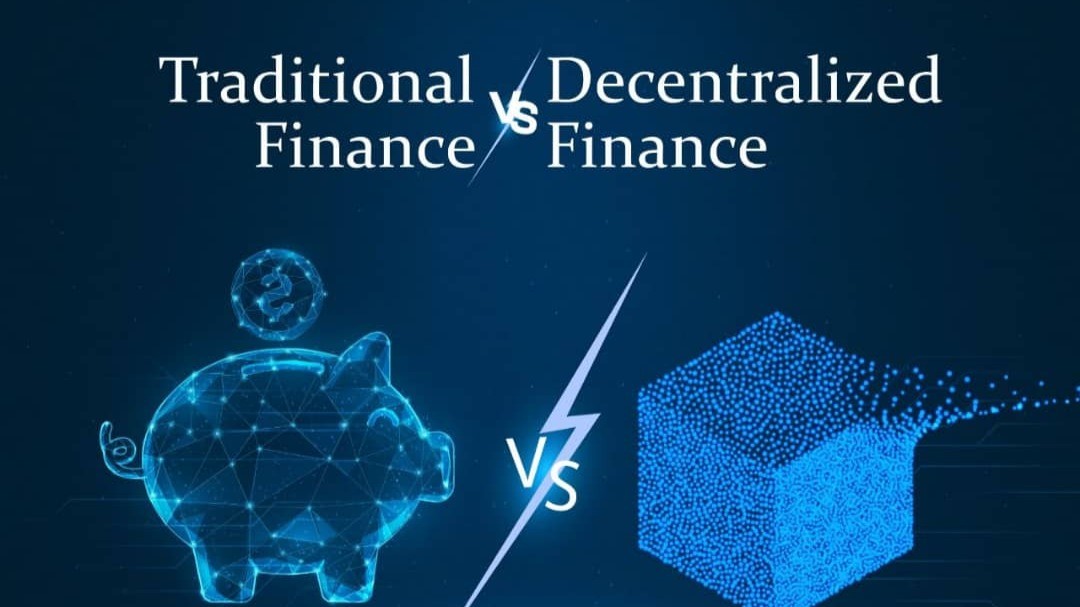
Over the past decade, financial technology has undergone a major transformation with the rise of Decentralized Finance (DeFi). Built on blockchain networks, DeFi aims to replicate and improve financial services such as lending, borrowing, and trading without relying on centralized intermediaries like banks or brokers. Meanwhile, Traditional Finance (TradFi)—the established banking and financial system—continues to dominate global markets with regulated institutions, established infrastructure, and consumer protections.
The growing popularity of DeFi raises an important question: Is decentralized finance a disruptive replacement for traditional banking, or will both systems coexist in a hybrid financial ecosystem? Understanding the similarities, advantages, and limitations of each system reveals the potential paradigm shift occurring in modern finance.
Understanding Traditional Finance
Traditional finance refers to the centralized system of financial institutions, including banks, stock exchanges, insurance companies, and payment processors. These organizations act as intermediaries that manage financial transactions and maintain trust between parties.
For example, when someone applies for a loan through a bank, the institution evaluates the borrower’s credit score, income, and collateral before approving the loan. Similarly, stock trading occurs through regulated exchanges that oversee market integrity and compliance.
The strengths of traditional finance lie in regulation, stability, and consumer protection. Governments regulate banks to ensure financial security, often providing deposit insurance and legal recourse for customers. However, the system also has drawbacks, including slow processes, high fees, and barriers to entry for people without access to banking infrastructure.
Globally, billions of individuals remain unbanked due to strict requirements, geographical limitations, or lack of identification. These barriers highlight the limitations of centralized financial systems and create opportunities for alternative models like DeFi.
The Rise of Decentralized Finance (DeFi)
Decentralized Finance operates on blockchain networks using smart contracts—self-executing code that automatically processes financial transactions. Instead of relying on banks or financial institutions, DeFi platforms enable peer-to-peer interactions directly between users.
Through decentralized applications (dApps), users can access services such as:
- Lending and borrowing: Users lend crypto assets to earn interest or borrow funds using cryptocurrency as collateral.
- Trading: Decentralized exchanges allow users to trade tokens without intermediaries.
- Yield generation: Activities like staking and liquidity provision generate returns on digital assets.
Because DeFi platforms operate on public blockchains, financial services become permissionless, meaning anyone with an internet connection and digital wallet can participate. This open access significantly lowers barriers compared to traditional financial systems.
Comparing Core Financial Services
Lending and Borrowing
Traditional bank lending relies heavily on credit checks, income verification, and approval processes. This approach helps reduce risk but can exclude individuals without formal financial records.
In contrast, DeFi lending uses smart contracts to automate the process. Borrowers deposit cryptocurrency as collateral, and loans are issued instantly according to predefined conditions. This removes bureaucratic delays and enables global access to credit markets.
However, DeFi loans typically require overcollateralization, meaning borrowers must deposit assets worth more than the loan itself. While this protects lenders, it limits accessibility for people who lack digital assets.
Trading and Asset Exchange
Traditional trading takes place on centralized exchanges with regulated intermediaries that manage order matching, settlement, and compliance.
DeFi trading, on the other hand, often occurs through decentralized exchanges using automated market makers (AMMs) rather than traditional order books. These platforms allow continuous trading without centralized oversight.
While decentralized trading offers greater transparency and accessibility, traditional exchanges still dominate due to higher liquidity, regulatory compliance, and established investor trust.
Advantages of DeFi
1. Accessibility and Financial Inclusion
One of DeFi’s most transformative advantages is its ability to reach individuals excluded from traditional banking systems. Anyone with a smartphone and internet connection can access financial services such as payments, lending, and investing.
This accessibility makes DeFi particularly valuable in regions where banking infrastructure is limited or unstable.
2. Transparency
DeFi transactions are recorded on public blockchains, allowing anyone to verify activity. This transparency contrasts with traditional finance, where many internal processes remain opaque and controlled by institutions.
Transparent smart contracts also reduce reliance on trust between parties, since rules are encoded and automatically enforced.
3. Efficiency and Lower Costs
By eliminating intermediaries, DeFi reduces operational costs associated with financial services. Transactions can occur within minutes rather than days, especially for cross-border payments.
Moreover, decentralized platforms operate 24/7, unlike traditional banking systems that depend on business hours and manual approval processes.
Limitations and Risks of DeFi
Despite its advantages, DeFi faces several significant challenges.
1. Market Volatility
DeFi relies heavily on cryptocurrencies, which can experience rapid price fluctuations. Volatility can trigger automatic liquidation of collateralized loans when asset values drop sharply.
This instability makes DeFi riskier than traditional financial instruments tied to stable currencies.
2. Security and Smart Contract Risk
Smart contracts automate financial transactions, but coding errors or vulnerabilities can be exploited by attackers. Hacks and exploits have resulted in significant financial losses within DeFi platforms.
Unlike traditional banks, users often have limited recourse if funds are stolen or lost.
3. Regulatory Uncertainty
Traditional financial institutions operate under strict regulatory frameworks designed to protect consumers and maintain market stability.
DeFi, however, exists in a relatively uncertain regulatory environment. Governments worldwide are still determining how to regulate decentralized systems without stifling innovation.
This uncertainty may slow adoption among institutional investors.
Case Studies of Adoption
Emerging Markets and Financial Access
In regions with limited banking infrastructure, DeFi has begun to provide alternative financial services. Individuals in economically unstable countries sometimes use stablecoins and decentralized platforms to protect savings from inflation or capital controls.
This demonstrates how DeFi can function as a financial “lifeboat” where traditional banking systems struggle.
Institutional Experiments with Blockchain
Rather than resisting decentralized technologies entirely, many financial institutions are exploring ways to integrate them. For example, some banks are experimenting with blockchain-based payment networks and tokenized assets.
Additionally, certain DeFi projects have introduced real-world asset collateral, allowing loans backed by traditional financial assets. These developments show growing collaboration between decentralized and institutional finance.
Coexistence or Disruption?
The debate over whether DeFi will replace traditional finance remains unresolved. While DeFi introduces groundbreaking innovations, traditional finance still offers advantages in regulation, stability, and consumer protection.
A more likely scenario is financial convergence, where both systems evolve together:
- Traditional banks adopt blockchain technology for faster settlements and improved transparency.
- DeFi platforms incorporate regulatory compliance and institutional-grade security.
- Hybrid financial products bridge decentralized infrastructure with regulated markets.
Such collaboration could create a more inclusive and efficient global financial system.
Conclusion
The emergence of decentralized finance represents one of the most significant shifts in modern financial history. By enabling permissionless access, transparent operations, and automated financial services, DeFi challenges the long-standing dominance of traditional banking.
However, DeFi is not without its limitations. Volatility, technological risks, and regulatory uncertainty remain significant barriers to widespread adoption.
Rather than a complete replacement of traditional finance, the future likely lies in a hybrid ecosystem where decentralized innovation complements institutional stability. As technology continues to evolve, the interplay between DeFi and traditional finance will shape the next generation of global financial systems—one that may be more open, efficient, and inclusive than ever before.